
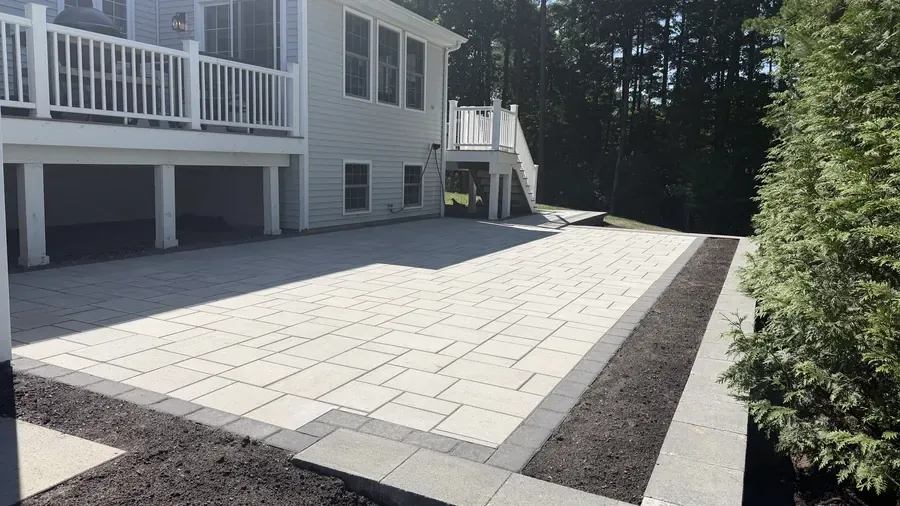
Patio Pavers
Patio Pavers Installation in Rockland, MA and the South Shore
Paver patios built on a properly excavated, compacted base, with drainage and edge restraint, so your outdoor living space stays level for decades.
- Licensed and Insured
- Google Guaranteed
- Up to 10-Year Warranty
- 10+ Years of Experience
- Free In-Home Consultation
Patio pavers
Paver Patios Built as a Complete System
Backyard Experts builds paver patios for homeowners across the South Shore, Plymouth County, and Greater Boston. A paver patio is a layered system: excavated soil, a compacted gravel base, a bedding layer, interlocking pavers, edge restraint, and joint sand, all working together so the surface stays level, drains, and carries weight for decades.
The pavers are the part you see. What decides whether the patio still looks right after ten winters is the base underneath it and where the water goes.
Every patio we build is designed to:
- Turn a muddy or unused yard into living space
- Stay level through freeze and thaw cycles
- Shed water away from the house and the patio
- Resist the cracking that ruins concrete slabs
- Connect to walls, steps, fire pits, and walkways
If your backyard is muddy, uneven, or simply not used, start with a free in-home consultation. We do not provide landscaping, tree work, lawn care, mowing, or garden maintenance.
When you need one
Do You Really Need a Paver Patio?
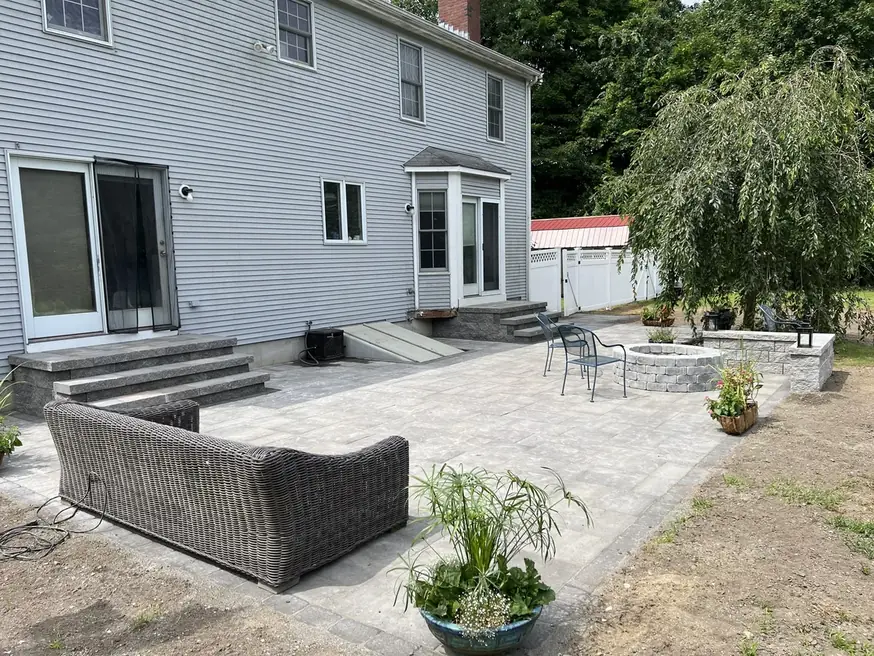
A paver patio makes sense when part of the yard is not usable, not safe, or not draining. Pavers are not only a finish. They solve ground problems that a lawn, loose gravel, or a rigid slab cannot, because the base spreads the load and the joints let the surface flex instead of crack.
Common conditions that call for a patio:
- A muddy or bare area outside the back door
- Water that pools near the house after rain
- A cracked or heaved concrete slab
- Uneven ground that makes chairs and tables wobble
- A yard with no defined place to sit, cook, or gather
When a patio may not be the best option:
- An elevated space where a deck makes more sense
- A steep slope that first needs a retaining wall
- A small, dry area where simple gravel is enough
Cause, effect, and the structural solution:
- Water pooling softens the ground, solved with grading and a drained base
- Weak soil lets the surface sink, solved with excavation and compaction
- Rigid concrete cracks in winter, solved with flexible interlocking pavers
- A slope leaves no flat space, solved with a wall and a patio together
Our process
What’s Included in Our Patio Installation
Every patio we build goes through the same sequence, because each layer protects the one above it. Skipping a step is how patios end up sinking at the edges or holding puddles after two winters. The work below is included in every patio estimate, not sold as an extra once the job has started.
- 01
Layout and Design
Size, shape, paver style, borders, and how the patio connects to the house and the yard.
- 02
Excavation
We remove grass, topsoil, and unstable soil down to the depth the base needs.
- 03
Compacted Base
Crushed stone installed and compacted in layers, so the patio carries weight evenly.
- 04
Grading and Drainage
A gentle pitch away from the house, so rain runs off instead of pooling.
- 05
Pavers and Edge Restraint
Pavers set on a screeded bedding layer, locked in place by a solid edge.
- 06
Polymeric Sand and Cleanup
Joints filled and compacted, the surface cleaned, and the edges restored.
Patio work we do:
Retaining Walls Walkways Pool Deck Resurfacing Hardscape Contractor
Base systems
Patio Base Systems and When Each One Is Used
Not every yard gets the same patio base. The right system depends on the soil, the water on the site, and how the patio will be used. The table below shows the base systems we use most often on the South Shore and when each one makes sense for a homeowner’s backyard.
| Base System | When It Is Used |
|---|---|
| Standard Paver Base | Stable, well-drained soil and normal patio use |
| Reinforced Base | Weak or clay soil, or heavy items like a fire pit or a kitchen |
| Drainage-Integrated Base | Yards where water collects after rain |
| Permeable Paver System | Sites that need rain to soak in instead of running off |
Choosing the wrong base is the most common reason patios shift, sink, or hold water.
Pricing factors
What Affects the Cost of a Paver Patio
Patio pricing is driven by what the site needs, not only by square footage. Two patios of the same size can cost very different amounts when one sits on dry, flat ground and the other needs deep excavation, drainage, and steps. That is why we price every patio after a site visit, with a written estimate.
Patio costs depend on:
- Size and shape of the patio
- Soil condition and excavation depth
- Drainage the site needs
Also considered:
- Paver or natural stone selection
- Borders, steps, seat walls, and fire pits
- Access for equipment
The free in-home consultation gives you a real number for your yard, not a guess per square foot.
Compare
Paver Patios vs Related Options
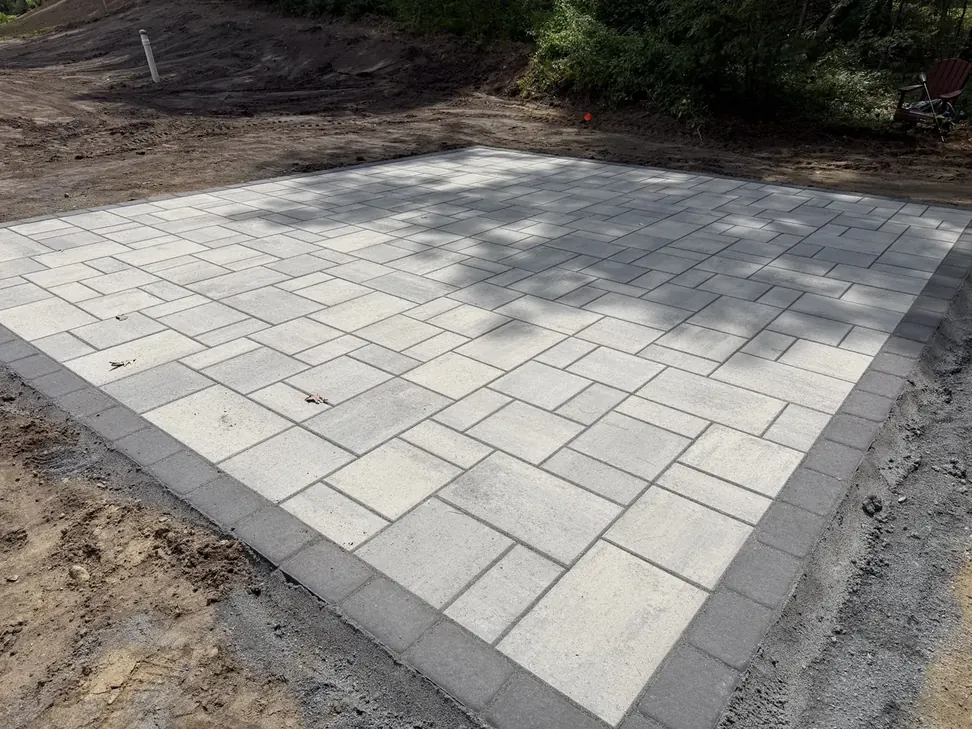
Homeowners usually compare a paver patio with a poured concrete slab or a wood deck. Each one works in the right place. The table below shows what each option does well and where it falls short, so you can decide which surface fits the way you want to use your yard.
| Option | When It Works |
|---|---|
| Concrete Slab | A plain surface where cracking and repairs are acceptable |
| Wood or Composite Deck | Elevated spaces off a second floor or over a steep drop |
| Paver Patio | Level living space that drains, flexes, and can be repaired by the unit |
| Retaining Walls | Slopes that must be held before a patio can sit level |
| Hardscape Contractor | Patio, walls, steps, and walkways planned together |
Retaining Walls Hardscape Contractor All Hardscaping Services
Built to standard
Industry Standards for Patio Installation
A patio is only as good as the method used to build it. We follow the installation guidelines of the Interlocking Concrete Pavement Institute for excavation depth, base compaction, bedding, edge restraint, and joint sand. Those standards are what keep a paver patio flat and tight for decades instead of a few seasons.
Backyard Experts operates with:
- Licensed and insured operations
- Our own trained crew on every project
- Excavation and base depth sized to the load
- Drainage planned before the first block is set
- Installation following ICPI and NCMA guidelines
- Permits handled when the town requires them
- Clean, protected job sites
These standards ensure:
- Walls that stay plumb and stable
- Water that drains instead of pushing
- Protection of your foundation and driveway
- Long-term value for the property
Why us
Why Choose Backyard Experts
Backyard Experts is a hardscaping and masonry company based in Rockland, MA, not a lawn care company that also builds walls. Our goal is not simply stacking block. It is building a structure that handles your soil, your slope, and New England winters, and still looks right ten years from now.
- Licensed and Insured
- Google Guaranteed
- Up to 10-Year Warranty
- 10+ Years of Experience
- Free In-Home Consultation
- Our Own Crew, Led by Owner Ronnie
- Hardscaping and Masonry Only
- Written Estimates Before Work Begins
- Clean Job Sites and Restored Lawn Edges
- Based in Rockland, MA
Where we work
Service Areas
Backyard Experts is based in Rockland, MA and builds patio pavers for homeowners throughout the South Shore, Cape Cod, and Greater Boston. Our crew works in the Massachusetts communities below, from Plymouth County to Cape Cod and Greater Boston, and if your town is nearby but not listed, call us to confirm availability before you schedule.
- Rockland, MA
- Abington, MA
- Bridgewater, MA
- Brockton, MA
- Carver, MA
- Duxbury, MA
- East Bridgewater, MA
- Halifax, MA
- Hanover, MA
- Hanson, MA
- Hingham, MA
- Hull, MA
- Kingston, MA
- Lakeville, MA
- Marion, MA
- Marshfield, MA
- Mattapoisett, MA
- Middleborough, MA
- Norwell, MA
- Pembroke, MA
- Plymouth, MA
- Plympton, MA
- Rochester, MA
- Scituate, MA
- Wareham, MA
- West Bridgewater, MA
- Whitman, MA
- Braintree, MA
- Brookline, MA
- Canton, MA
- Cohasset, MA
- Dedham, MA
- Dover, MA
- Foxborough, MA
- Franklin, MA
- Holbrook, MA
- Medfield, MA
- Medway, MA
- Milton, MA
- Needham, MA
- Norfolk, MA
- Norwood, MA
- Plainville, MA
- Quincy, MA
- Randolph, MA
- Sharon, MA
- Stoughton, MA
- Wellesley, MA
- Westwood, MA
- Weymouth, MA
- Wrentham, MA
- Barnstable, MA
- Bourne, MA
- Dennis, MA
- Falmouth, MA
- Harwich, MA
- Mashpee, MA
- Sandwich, MA
- Yarmouth, MA
- Natick, MA
- Newton, MA
- Attleboro, MA
- Easton, MA
- Fall River, MA
- Mansfield, MA
- New Bedford, MA
- Raynham, MA
- Rehoboth, MA
- Somerset, MA
- Swansea, MA
- Boston, MA
And surrounding Massachusetts communities.
Free estimate
Start the Patio You Will Actually Use
A yard that stays muddy, uneven, or empty does not fix itself, and a slab that has started cracking will keep cracking. A paver patio on the right base gives you a level, dry place to sit, cook, and gather, and it keeps looking right year after year.
Call (774) 341-4894 or request your free in-home consultation online, and we will plan the right patio for your yard.
- Licensed and Insured
- Google Guaranteed
- Up to 10-Year Warranty
- 10+ Years of Experience
- Free In-Home Consultation
- Based in Rockland, MA
FAQ
Frequently Asked Questions About Patio Pavers
These answers cover the questions homeowners ask most often about patio pavers: durability, pavers versus concrete, drainage, maintenance, repairs, and cost. If your question is not listed, call Backyard Experts at (774) 341-4894 and we will explain the options for your property in plain language.
What are patio pavers?
Patio pavers are individual concrete or natural stone units laid over a compacted gravel base and a bedding layer, then locked together by an edge restraint and joint sand. Because each unit can move slightly with the ground, a paver patio flexes through freeze and thaw cycles instead of cracking like a single concrete slab.
How long do patio pavers last?
A paver patio built on a properly excavated and compacted base can last for decades. Most patio problems we are called to fix come from a thin base, poor drainage, or a missing edge restraint, not from the pavers themselves. Our work is backed by a warranty of up to 10 years.
Are pavers better than a concrete patio?
For most yards in New England, yes. Concrete is one rigid piece, so when the ground heaves in winter it cracks, and the repair rarely matches. Pavers flex with the ground, drain at the joints, and can be lifted and reset in one small area if anything ever settles.
Do patio pavers need maintenance?
Very little. Sweep the patio, rinse it once or twice a year, and keep the joints full. Over time some joint sand may need topping off, and some homeowners choose to clean and seal the surface every few years to refresh the color. There is no repainting and no annual sealing required.
Do paver patios help with drainage?
Yes, when they are built correctly. We grade the base so the patio pitches gently away from the house, and the joints let some water pass through. On wet sites we add drainage to the base or use a permeable paver system, so rain soaks in or runs off instead of pooling.
Can a sinking or uneven patio be repaired?
Often it can. Pavers can be lifted, the base underneath corrected and compacted, and the same pavers reset level. When most of the patio is sinking, the base was usually built wrong from the start, and we will explain whether releveling or a full rebuild is the better investment.
Can you add a fire pit or seat wall to a patio?
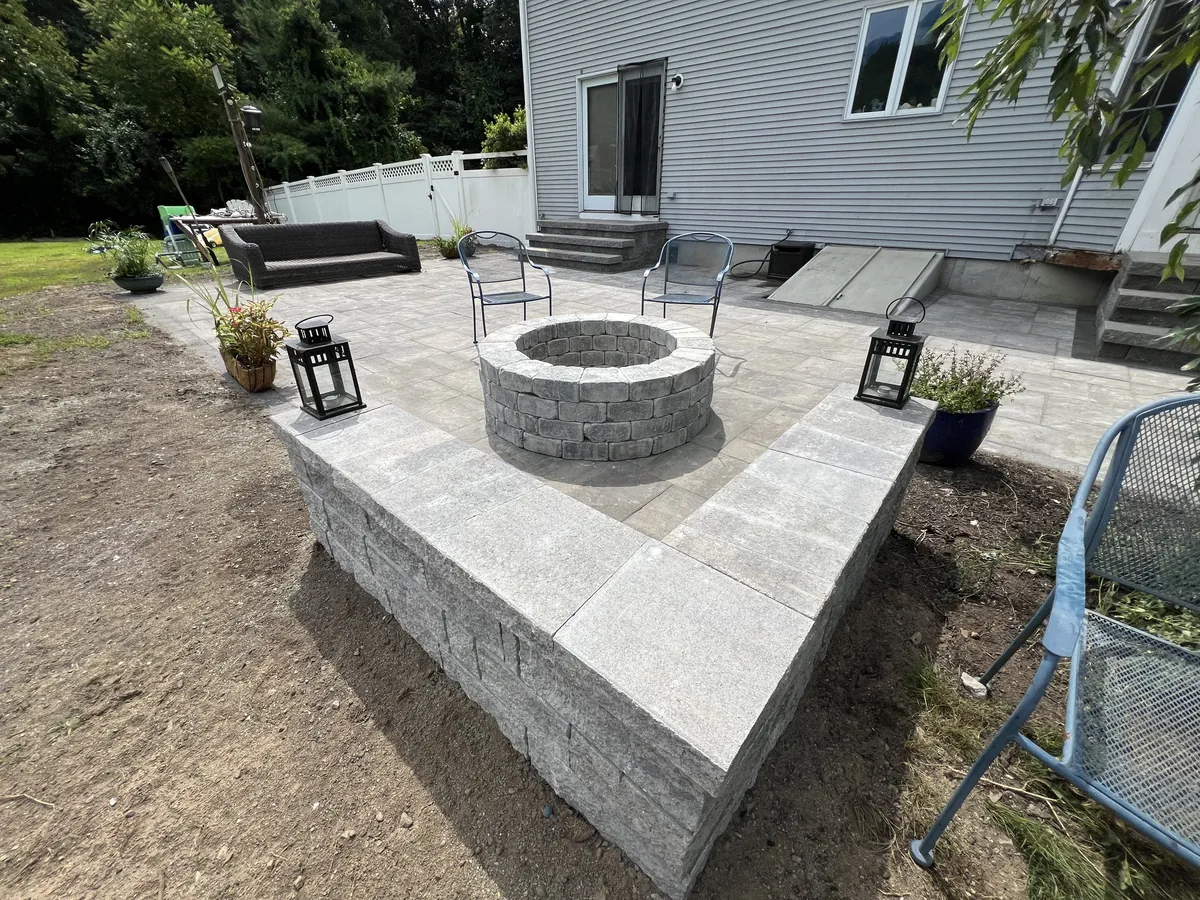
Yes. Fire pits, curved seat walls, steps, borders, and lighting are some of the most common additions we build with a patio. Planning them together lets us set the base and the drainage for the extra weight and keep the materials and colors consistent across the whole space.
How long does patio installation take?
Project length depends on the size of the patio, the excavation, any walls, steps, or fire pits, material delivery, and the weather. A simple patio takes far less time than a large patio with seat walls and lighting. We give you a clear schedule before work begins and keep you updated.
How much does a paver patio cost?
The cost depends on the size and shape of the patio, the soil and excavation depth, the drainage the site needs, the paver or stone you choose, and extras like borders, steps, and fire pits. We price every patio after a free site visit, so the estimate reflects your yard and not a generic rate.
Do you also do landscaping or lawn care?
No. Backyard Experts specializes in hardscaping and masonry: patios, retaining walls, driveways, walkways, pool decks, and steps. We do not provide lawn care, mowing, landscaping, or garden maintenance. After building a patio we restore the soil around the edges, but planting and ongoing yard care are not part of our service.